I believe all of these things are true:
Large language models (LLMs) are interesting, fun, and have the potential to aid in productivity.
Like everybody else who spends their day at a keyboard and isn’t given enough to do, I’ve played around with ChatGPT and a couple of the other implementations of the technology, and, hey look, I can make it talk like a gangster! Ha ha! And now it’s writing me a song about broccoli! That’s pretty great. The technology that makes this possible is both interesting and impressive. It is undoubtedly a milestone.
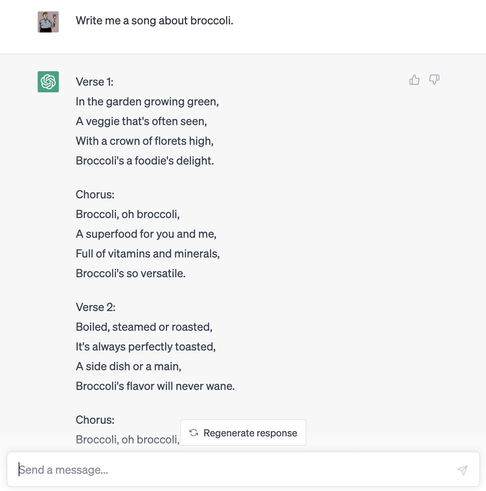
Likewise, I’ve seen the articles and essays and code cranked out by LLMs. Some of them are even correct, or close to correct, or, um, useful straw men.
I’m a coder, and my experience with ChatGPT-4 produced and reviewed code hasn’t been great. It knows language syntax and certainly has read all the documentation, but the results are lackluster where they’re not entirely wrong. If you’re looking for basic guidance or to solve a common problem, then those details are going to be in the training corpus and the system will happily burp them up. But LLMs don’t have any awareness of less popular domains, or a codebase’s history, or the culture that produced it, or a thousand other intangibles, and you can tell. Even when it’s right, it feels wrong.
But a lot of very smart people are finding value in LLMs, have gotten good results, and see a thousand ways to use them. Maybe I don’t have the knack for writing prompts. Maybe I’m too old or too myopic or too calcified. Maybe thirty years of increasingly hype-driven Next Big Things have left me a shattered, empty husk that can no longer experience excitement or joy.
I mean, that’s totally possible.
Large language models are not “artificial intelligence” and never will never be.
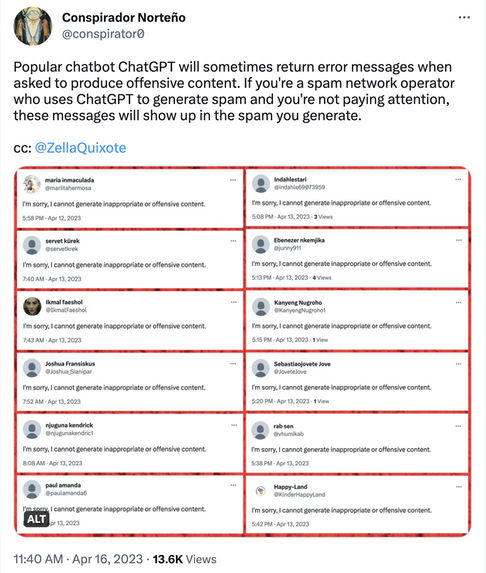
LLMs are eager idiots who have done the reading. They will always provide an answer, and if they have to invent one to do it, well, dammit, they’ll invent one. They are next-word prediction engines and so they predict the next word. That’s it. That’s the tweet. There’s no understanding of the words they produce, or of the ideas those words compose.
Any and all cognition in this scenario is done by the human reading the output. The emotional impact, the insight, the cleverness in any LLM result comes from the person in whose lap it lands, because the machine neither knows or cares (and, in fact, is incapable of knowing or caring).
All the sci-fi doomsaying about artificial general intelligence and our robot overlords shouldn’t be attached to LLMs any more than the space program should be attached to the invention of the wheel. It’s maybe a nod in that direction, but don’t go planning your “One small step” speech just yet.
Large language models, as currently constructed, have profound ethical issues.
LLMs suffer from that tech-endemic disease We’ll Figure It Out Later. Damn the torpedoes (where the torpedoes are composed of sensible questions with non-obvious answers), full speed ahead.
Training corpuses are gathered willy-nilly, without regard to intellectual property, and are (best-case) turned into opt-out after the fact. That’s not how science (or business, as long as we’re waist-deep in fantasy, talking about tech and ethics) is supposed to be done. There’s a green field to roll into and petty things like permission are small, endangered animals to be churned into mulch.
The models themselves are opaque, and effectively launder the origin of the data they use to produce results, while hiding the initial prompts that guide those results. It’s like using a browser that doesn’t show the URL and just maybe elides some of the text that it doesn’t want you to see. “I heard it from a guy” is not a falsifiable claim, and neither is “ChatGPT told me.”
LLMs stomp on the accelerator in the rush to the bottom. Full-time workers have become contractors have become gig workers and are now becoming mere clean-up editors for LLMs, for a while anyway. It doesn’t matter if the result is worse, it’s so much cheaper. Buggy-whip manufactures don’t have an obligation to continue to employ buggy-whip assemblers, but it might be worth our time to figure out if we want to sever the implicit human-to-human connection that was previously central to our information consumption. We’ll no longer just be bowling alone, but thinking alone.
And all this is just a small part of the fact that the introduction, adoption, and soon-to-be universality of LLMs is market driven. Horrible things will be done in the name of simply getting to do them first. There’s already an LLM-involved suicide. As is usual, vulnerable populations have not been invited to the sticky orgy of capitalism that is the coming paradigm shift. The first to get hurt are always the last to have a say.
Expanding on the previous point, large language models are going to do monumental societal damage through the near total destruction of our information landscape.
And, of course, squatting atop the pile of ethical concerns, like an oily toad or Steve Bannon, is disinformation. LLMs don’t “lie” any more than bingo machines lie — they just drop what they drop. But the result can be jury-rigged by the people running them. Do you really think the malignant villains who ran Cambridge Analytica, or manufactured anti-(trans, critical race theory, immigration, witch; pick one) moral panics, or introduced the brand-new phrase “Jewish space lasers” are not going to use this particular nuclear weapon? It is the stuff of their dreams.
The already blasted heath of our information ecosystem is going to be turned into a single smooth pane of glass, where facts will have no purchase. If a literal clown like Donald Trump and and a handful of backwater forums could summon up a real-world attack on the Capitol during the democratic transition of power, what does the world look like when those forces are expanded by a few orders of magnitude? What does the fascist “flood the zone with shit” strategy look like when the shit-production is not only fully automated, but infinite and cheap? Our institutions could barely deal with the sluice of effluvia being vomited out by bad actors in 2020. 2024 is going to make that look like a gardening newsgroup from 1993.
We are living in the last days of an antediluvian information ecosystem. The dam has leaked for years. It’s about to burst.
But, hey, a song about broccoli. Ha ha!
Large language models aren’t going back in the bottle.
And with all that said: This is what we’re stuck with. LLMs may join the set of tools that people use every day as a matter of course. Or they may not. The hype could die, the revolution could end, the breakneck pace of previously-unimaginable invention could top out and sputter and leave us shy of anything that actually, consistently, universally works. LLMs might be consigned to the same niche-useful, half-there limbo of every previous generation of “AI,” like expert systems and hotdog detectors and ducking autocorrect.
But, either way, we’ll have to learn to live (or not, depending on how 2024 turns out) with LLMs pumping ceaseless garbage into every media channel and societal narrative that exists, from here on out. The Internet made one-to-N publishing possible for anybody. We were naïve to think that was an unalloyed good. The inevitable weaponization of LLMs are the ultimate expression of why.
On September 12, 2018, Apple Inc. — you may have heard of them — held a big event at their Cupertino headquarters (Spanish for “What pert headquarters!”) to announce the latest models of their utterly beloved nightmare machine: the iPhone XR, the iPhone XS, and the iPhone XS Max. I’m seriously not making up that last one.
On September 17, 2018, I updated Romantimatic — you have not heard of it — to work with these new models, and submitted it to the App Store, the only place to get appetizers for the iPhone. The App Store is managed by Apple and includes a fairly strict set of rules for the programs that are available through it, effectively giving Apple complete control over the expensive device their customers have purchased. Fun! This has previously caused some controversy in the fart app space.
In the release details for the new version of the software, I included the following note:
Added support for iPhone XR and iPhone XS Max.
(The iPhone XS is the same size as the previous generation’s iPhone X, and so no updates for it were needed.)
Apple responded with a rejection:
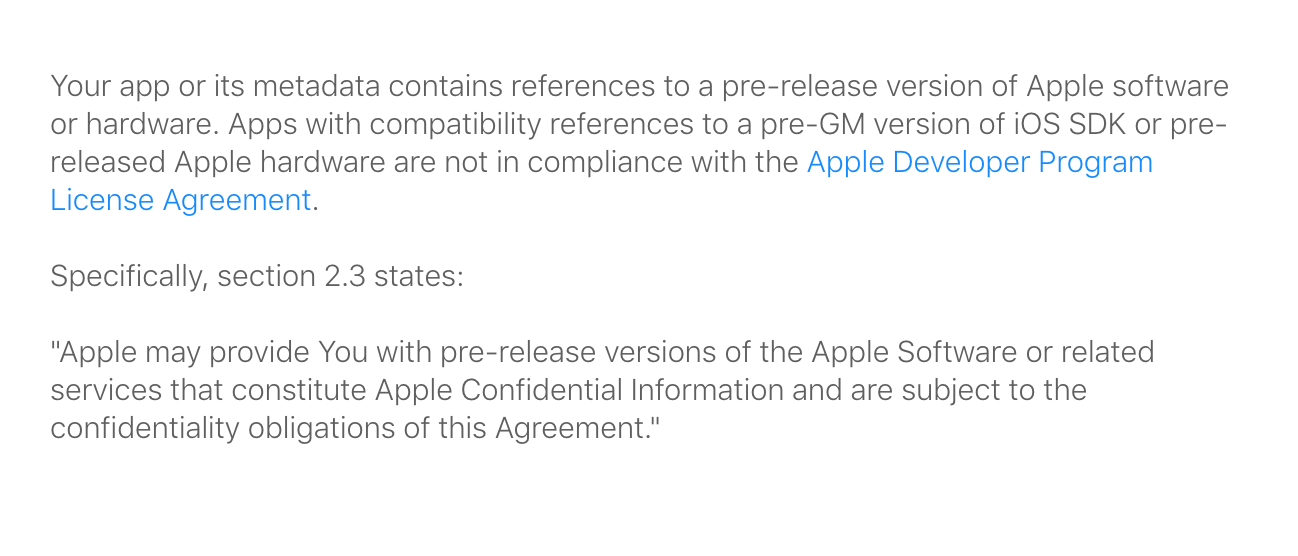
They didn’t actually explain what was wrong, but developer-community scuttlebutt was that Apple prohibited mention of the new models of their delightfully buttery black obelisk of death in release notes until the phones were actually, y’know, released. Despite the fact that several white men with artfully casual jeans had spent hours talking about those very models the previous week, and the names were currently plastered all over apple.com, which is the “Web site” of a music company founded by the Beatles.
So on September 18, 2018, I modified the release notes and resubmitted the app:
Added support for theoretical new iPhones that can’t be mentioned in release notes even though they were announced at a huge event at Apple’s headquarters and are currently featured on Apple’s website.
You’ll note that I didn’t mention the names “iPhone XR” or “iPhone XS Max.” However, Apple again responded with a rejection:
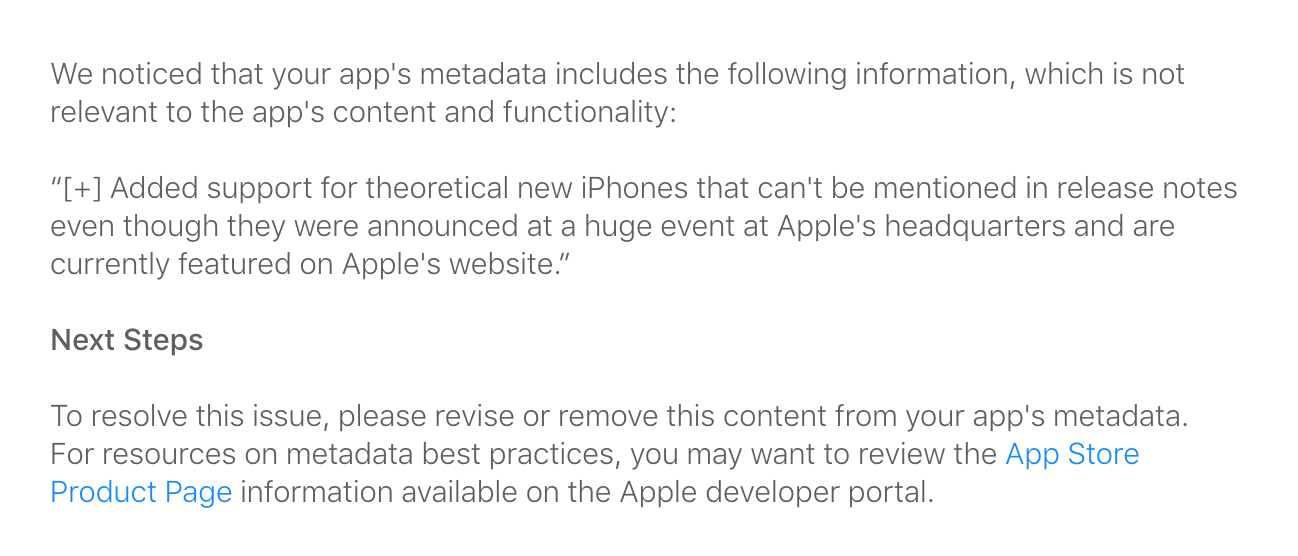
Apple apparently considers referencing the devices that an application is designed to run on not relevant to its functionality.
So on September 20, 2018, I squared my shoulders, modified the release notes again, and resubmitted the app:
A change was made. We can’t tell you what the change was, because that’s disallowed by Section 2.3 of the Program License Agreement. But we can’t _not_ tell you what it was, because that’s disallowed by Section 2.3 of the App Store Review Guidelines. This leaves the app in a state of quantum indeterminacy, and the waveform can only collapse when someone doing App Store reviews stops observing it.
Apple — sensing that I might not be taking the process seriously — responded with:
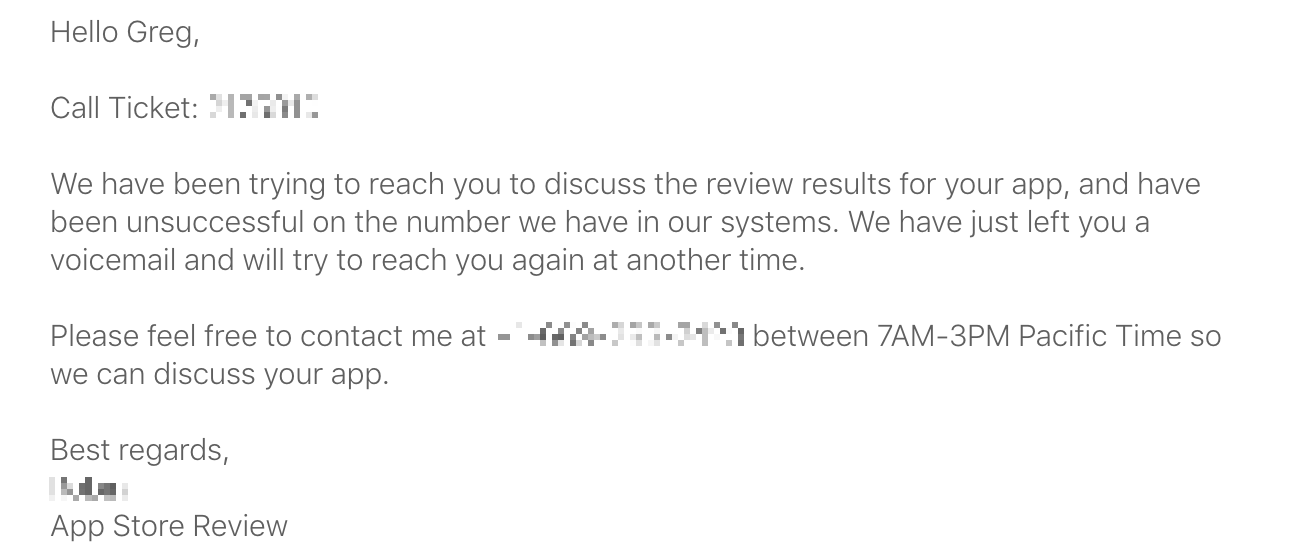
You can literally hear this message sigh.
Clearly, I’m being an obstinate jerk — I was told to write what I know. But, look: the world is a nightmarish hellscape of unending despair, and so the hill I have decided to plant my flag on is this tiny bit of sanity, where common sense might make fractional headway against the rote devotion to no-longer-relevant rules. Given Apple’s ad budget, the entire observable universe is aware what the new-model iPhones are called, and there’s simply no reason not to accurately reflect that in release notes. Not doing so makes the notes worse, and at the end of that particular road is a sign that just says, “Bugs fixed.”
Today, September 21, 2018, I had a call with a very patient member of the App Store Review Team, who reminded me that, “It’s inappropriate to comment on App Store review policy in release notes.” I asked how I might be able to, y’know, mention that the app supports [REDACTED], and she said that the iPhones XS and XS Max can now be referenced, since they just shipped. However, including the phrase “iPhone XR” or alluding to some announced, advertised, demoed but technically theoretical new phone will result in another rejection, up until October 26, 2018, when something will be released. Maybe it will be a flamethrower, or humane treatment for Foxconn workers, or a phone for less than I paid for my first car! Who can say?
I know this is a ridiculous fight. I know that I agreed to this particular barrel of foolishness when I signed up to be an Apple developer. I know this is small potatoes, and that the country is on fire. I know that millions of people are battling every day for their dignity and their families and their lives. But, goddammit, this is a bridge too stupid, and I can’t cross it.
Fly the pirate flag, toss a hammer at Big Brother, think different — just don’t violate Section 3.2 of the Program License Agreement, and communicate to your users words that are on a billboard you drove past on your way to work. Be a rebel, but somewhere else.
I thought my experience with the iPhone 6 battery throttling was Apple at its lowest: thoughtless, arrogant, and self-satisfied. But this particular rodeo manages to stumble past that, and a sound technical decision accompanied by silence and denials makes more sense to me than a galactically stupid, wholly unnecessary, purely arbitrary policy clearly communicated. This is the corporate equivalent of a Trump tweet.
On the Apple website, the iPhone XR section is beautiful. It shows the phone, in multiple colors, against a stark black background. “Brilliant,” it says, “In every way.”
I can actually think of one case where that’s not true.
There are two types of people: TCP people and UDP people. (Yes, those are Internet protocols. I’m the guy who wrote software to text my wife. Of course I’m going to classify people by Internet protocols.)
TCP, the protocol, guarantees delivery. When you send something via TCP, you know it’s either arrived or it hasn’t. It’s a phone call, where the person on the other end keeps repeating, “Uh huh” to let you know that they’re listening.
UDP does not guarantee delivery. You send something off into the ether and have no idea if it eventually lands where it’s supposed. It’s the postal mail, where you drop a letter into the box, and there’s a chance that it will be waylaid somewhere, and you’ll never know.
TCP is used for reliable communication. UDP is used for mass communication. E-mail is delivered via TCP, a packet at a time, confirmed and verified. Video conferences are delivered via UDP, a torrent of data vomited willy-nilly towards its destination, and if some of it is lost along the way, well, it’s just a few frames, a hiccup that nobody will notice.
TCP people — people with the TCP personality type — consume everything in their feeds. Every tweet, every e-mail, every photo. They’re completists, and neurotic completists at that. “Mark as Read” makes them feel uncomfortable, like something that needed to be done has been left undone, without actually being able to say what it might be. The data, to a TCP person, was sent, so it must arrive. If it doesn’t, something is broken.
UDP people think TCP people are bonkers. They’ll dip in and out of whatever data happens to be sluicing towards them at any particular moment, without giving the slightest thought to what might have come before and what might come after. If it’s important, they think, it will probably come around again. Missing something, by definition, makes it unimportant.
I am a TCP person, a habit formed back when it was possible to be a TCP person and not be driven to whimpering madness by the constant deluge of text and images and video — there hardly was any video — and whatever else managed to crawl off stand-alone computers and onto the then-fledging Internet. Bandwidth, never mind the relatively few people contributing the the miasma, made it possible to keep up. You can cope with anything at 300 baud.
The world, today, many years after my habit formed, is UDP. Bandwidth doubled, and doubled again, and doubled again and again and again and again. The Internet was flooded with literally billions of people. More data has swung around the planet in the last week than in all of prior history combined. (I just made that up. But you believed it for a second, didn’t you?) There’s just too much, and if you’re intent on crawling through the endless sand of this particular beach, it’s a lot easier not to have to mark every grain as “Done”.
And so people are becoming UDP as well. People wander into and out of their Twitter stream, produced by the N-thousand people they follow, as time allows. They let Gmail decide which messages are important enough to highlight. They happily allow a thousand-thousand posts and tweets and pictures to sail by, without the slightest concern that they might have enjoyed any of them, because they know there’s a thousand-thousand times as much coming over the spillway.
UDP people are right: TCP like me are bonkers. We maintain a tradition in the complete absence of the circumstance that allowed that tradition to form. When the land we stand on finally sinks below the relentlessly rising tide, it’s the people who have adapted, transformed, evolved who will survive. The only place for TCP people in the post-diluvian world will be on the small outcroppings of rock that poke above the endless, endless sea, and the only approach TCP people will be able to take is to pretend that the vast deep that surrounds them doesn’t exist. The world is UDP, and the people who live in it need to be as well.
But it would have been nice if anybody had actually seen this post.
Today is the third anniversary of Romantimatic, a silly little app that caused a silly little ruckus. The app is intended to remind the forgetful or the distracted to text nice things to their sweethearts. This profound assault on true love offended the sensibilities of some non-trivial percentage of the world’s romantics, and their condemnation was swift and wide-spread and did more to help publicize the app than anything I ever did. Thank you, humorless scolds!
But in the years since, Romantimatic has suffered the same fate as most software in the App Store, in that it’s been almost thoroughly ignored. In 2016, Apple paid me $134 for my share of sales, which is even less impressive when you subtract the $99 they charge to put your program in the company store. When software needs a wider distribution than a pay-model is providing, the usual course is to lower the price to free and start throwing ads at the user. (There’s no evidence that this actually works, outside of a handful of anecdotal cases, but it is the usual course. The usual course when people find themselves drowning is to die — it’s not good, but it is typical.)
So Romantimatic is now free! With ads! If you were offended by the idea of an app that treats relationship maintenance as something that can benefit from mechanical assistance, intermediating that experience with advertisements should send you through the freakin’ roof. Remember to post your disapproval far and wide! Since it’s free, you should also download it and stare ruefully at an ad for flowers, before spontaneously and romantically deciding to send some to your sweetheart.
But, yeah, OK: Ads are tacky. They’re ugly and off-topic and almost always obnoxious. The race to the bottom is long over, and the podium is crowded with winners. But if I’ve decided to be tacky, I can be at least a little less tacky than the usual:
If you use Romantimatic to send four or more messages to your sweetheart in a week, the ads will disappear the following week. Keep it up, you sweet-talker, and you’ll never see an ad.
This is a terrible business model, because it means that the people who use the app the most will be delivered the fewest ads. But, hey, there’s reward in just knowing people are using the software I wrote, right? And maybe — just maybe — enough new people will download and use the app fewer than four times a week to out-earn the massive $35 pile of cash that the for-pay version was generating.
(Also, if you’ve bought Romantimatic in the past, you’ll never see ads. And, hey, you didn’t hear it from me, but there’s an Easter egg somewhere in there that turns them off for a month. You should totally download it and watch a lot of ads while looking for it.)
There’s been talk for years about the death of the app economy. I’d be willing to bet that — even with all the unexpected publicity, and the sales that resulted — Romantimatic never justified the time I spent on it. Heck, I’m just as bad as anyone — I bought the half-dozen apps I really use years ago, and have been satisfied ever since.
That means that for the vast majority of people writing iPhone software, the App Store is a hobby. That statement has well-trod and pretty dark repercussions for innovation and independence and the iOS ecosystem in general, but it’s also the source of enormous freedom. (Which, I note, is just another word for nothing left to lose.)
Hobbies are where you can experiment and play and screw up and try something that’s more than a little stupid. Rewarding dedicated users by removing ads is probably dumb. Maybe it’s not. But it’s action, it’s movement, it’s not-drowning. At the very least, it’s better than just sitting there, not thinking about it.
Which was the whole point of Romantimatic in the first place.
I don’t like epiphanies.
Or, rather, I love epiphanies, but I don’t trust them. They’re too easy — too simple and too addictive. Epiphanies don’t tell the whole story. They’re joyous little nuggets of surprise that present themselves whole and complete, as if all they require of you is to soak up the adrenaline and check off a box. Epiphanies don’t acknowledge the hard work that comes before, that comes after — the grinding effort of preparing and putting your newly won self-knowledge into practice.
XOXO is a festival of epiphanies. It’s loaded with them. In 2016 — as with every year previous — you couldn’t go half a day without having an epiphany, without having your heart suddenly and unexpectedly sprung open and the person on the stage going to work on it with a wrench. You can laugh and cry and laugh again, all in the course of a single talk, covering a fleeting twenty minutes of your life. XOXO will tear your heart out, and then carefully stitch it back in, straighter and truer and stronger than before.
Noting this is not new or insightful. The impact of XOXO on the culture of the Web and its surrounding creative environments is well documented, through hundreds of posts and thousands of tweets and, I’d bet, more than a couple of babies. Epiphanies have an undeniable power, in all their heart-stopping, brain-freeing glory. And if they were all that XOXO had to offer, it would still be an astonishing accomplishment.
But the festival has been so, so, so much more. I’ve been privileged — in at least a couple senses of the word — to attend each of the five years of XOXO, and beyond the heady rush of each year’s new epiphanies is the hard work that makes those insights possible. XOXO leaves a jaw-dropping legacy of constant, iterative, nuts-and-bolts improvement in its wake; half a decade of thoughtful, continuous effort applied toward the single goal of becoming better. And better and better. And better.
I’ve waited a week to post this, because I wanted to make sure that the feeling didn’t fade, that the notion wasn’t shallow, that I wasn’t fooling myself. I wanted the endorphins to wear off. And here, back deep in the grind, it remains:
The real accomplishment of XOXO isn’t just creating an environment where honesty and empathy and encouragement allow creative expression to bloom, but doing it every year, year after year after year, each time better than the last. If epiphanies are the beating heart of XOXO, then relentless hard work is its indefatigable lungs, providing the oxygen that allows the climb to happen at all.
The final epiphany of XOXO is that the festival itself is a perfect example of how to create something wonderful. It belongs on its own stage, teaching us its lessons.
Five years ago, people took cabs between their hotels and the venue. Two years later, a free shuttle made a continuous loop through Portland, tracked by an app you could put on your phone. This year, that free, app-tracked shuttle was both ADA-compliant and stocked with donuts.
In ways big and small, in ways important and not, XOXO is an object lesson in the value of continual improvement. The gender balance, child care, LBGT+ representation, non-alcoholic drinks, the number of attendees of color, contributions to the local homeless, quiet spots, an enforced code of conduct, free passes, water and a bottle to keep it in, a photo privacy policy, preferred-pronoun buttons, goddamned yoga on the goddamned roof — all have been added or improved during XOXO’s run, each making the experience better, by strengthening a foundation that you can launch a thousand epiphanies from.
It’s easy to get caught up in the emotion of XOXO. It’s easy to get get swept away. But what was on stage was only half of what the festival had to offer. The full depth of the experience requires an understanding and appreciation for everything that went on in the months before, and off in the wings, and while you were asleep. It’s there, in the dark and when it’s lonely, that the preparation and follow-up happen, the work that makes everything else possible.
This year, XOXO provided a dozen epiphanies, shared a hundred ideas, from the stage and in conversation and over drinks. But among all of those, the first and the last, is the fundamental, underlying insight that the festival itself has demonstrated, over and over, for the last five years: you can get better, no matter how good you are, if you do the work — tirelessly, relentlessly and with a profound and abiding belief that what you are doing matters.
Thank you, XOXO — Andy, Andy, the volunteers, the staff, the vendors, the attendees — for everything. I am a better person for what you taught me. And will be a better person still for the work you showed me I have yet to do.
Romantimatic — the little app I wrote to remind the distracted or forgetful to text nice things to their significant other — is a month old today.
It’s been an interesting month.
The app has sold just over 875 copies, across a couple of dozen countries, making me about $885. It has a four-and-a-half-star average in the App Store, and I’ve received a handful of enthusiastic e-mails. It has been the subject of coverage from Mashable, the CBC, Lifehacker and Kottke.
It has also been the target of a medium-level Internet pile-on. For those of you who don’t fully understand the scope and scale of the Internet, even a medium-level pile-on falls squarely into the “Holy crap” category of human interaction. The app has been flayed not for its implementation but for its conception, often in the language of the Web, by which I mean the most hyperbolic terms possible.
Derision from Cult of Mac. Disapproval from Esquire. The accusation that my goofy project has killed romance as we know it from Elle. Fifteen hundred words of high-minded arm-chair psychology and moral indignation from the Atlantic, including the comparison of the app’s users to — reductio ad absurdum — those who need reminding not to harm animals. And thousands and thousands of excoriating tweets.
Like I said, it’s been an interesting month.
The criticisms, with varying degrees, all come down to the same sentiment: If you need or want this app, you are a bad person, and you should feel bad about yourself.
This is not a rational argument — it’s an emotional one. I don’t believe, in fact, there is a rational argument to be made here, against the app. It’s not evil, by any sane definition of the word. It’s not hurtful. It does not do damage to the user or to others. Everyone who has argued so vehemently against it could have just as easily quietly noted its existence, decided it wasn’t for them, and moved on, without moral obligation or qualm.
But this is the Internet, and such things do not happen.
I’ve been around long enough to develop the three essential tools that on-line life requires — a sense of humor, a sense of perspective and a thick skin — and they’ve served me well here. The criticisms amuse more than trouble, and it’s been interesting being on the receiving end of one of the many, many hullabaloos that roil the Web every day. I do not feel a need to defend myself or the app or the people who are happily using it. We’ll go our way and you — with that disapproving frown — will go yours.
But I am intrigued by the reaction. With the opportunity to simply let this particular leaf on this particular river float by, why condemn? Doubly so when nothing is at stake? How could a few thousand lines of computer code provoke such a response, especially when there is at least a subset of the population who seems to really appreciate those exact same few thousand lines?
An experiment: What if the app had been to help people diet? Let’s say, just pure flight-of-fancy here, that I’m a fat guy, instead of the male underwear model with incredible abs that I clearly am. Would an app to remind people not to eat be vivisected in the same way that Romantimatic has? Would the people who use it be vilified as weak-willed? Thoughtless? Hollow? My guess is not. My guess is they’d get inspirational TV shows.
So what’s the difference? Why is mechanical help with relationships out of bounds, but help with weight control not? Why is one type of self-improvement aid worse than the other?
The difference, for me, comes down to empathy. We — the majority of us — need help with our weight. (Note to international readers: I’m an American. Seriously, the majority of us need help with our weight.) It’s an easy enough problem to understand. Ice cream is delicious, exercise sucks, and so a little nudge in the right direction is appropriate, even appreciated.
But we — the majority of us — apparently do not need help remembering to text our significant other. (Or — cough — think we don’t.)
And that’s the difference, isn’t it? What we can imagine ourselves doing, or needing, or wanting. Those people who don’t need the help feel free to judge those who do.
They judge us by our failures and not our desire to improve. They judge us by our tools and not what we can accomplish with them. They judge us by their own standards, without a breath given to the possibility that a different perspective might exist.
Which is pretty much the Internet in a nutshell, isn’t it? Exposed to the entire spectrum of human enthusiasms, it’s basically impossible not to judge. Our empathy overloads and gives up and we sit, staring at the screen aghast, that somebody, somewhere might actually believe that what they’re doing is OK, is acceptable, is even appropriate.
Everybody is somebody else’s monster.
But I’m not defending the app, remember. This isn’t about the app. It’s about how we — all of us — use the Internet, how we interact with each other. I’m just as guilty as anybody who assed-wise about Romantimatic. You can check my Twitter history and see. I wouldn’t wish an Internet fusillade on anybody — well, almost anybody — but being subject to one has been instructional and humbling. How am I any different?
This isn’t some mealy-mouthed plea for all of us to get along, to say that criticism doesn’t have an important place, on-line or otherwise. Critics and criticism are powerful, vital forces in any endeavor. But criticism should have some foundation in a shared world, a common set of resources and interests. I mock Republicans because I believe their policies do damage to the country I love. I criticize start-up culture because I believe it’s corrosive to technological progress and the people who create it. I rage at mass shootings and the people who defend the status quo because there are dead children littering the streets. These things affect me, are deeply important to me, so they require judgement and — sometimes — condemnation.
That’s not what I’m talking about here. What I’m talking about here is how addictive the righteousness that comes from that condemnation is, and how we will apparently turn to any source we can find for it — even when that source is not evil or harmful or part of any world we exist in or understand.
A few years ago, a photo made the rounds. It was taken from the back, its subject unaware. He was a fat guy wearing a jeans-jacket, and on the back he had stenciled the name of his heavy metal band. It was a sloppy and amateurish job. The photo earned a lot of mocking comments in my circle, including from me. Ha ha, look at the fat guy with the rock-and-roll pretensions. Look at him. Looooook.
And then someone said, “I think he’s awesome. He’s found something he loves, and he thinks it’s great enough to share with the world. This guy is a hero.”
And… Oh, my God. That’s right. That’s exactly right. Who was I to judge, much less judge publicly? Maybe his music was terrible, but so what? It wasn’t for me. It was for him, and his friends, and his fans. Nobody was seeking my opinion, because it would be ill-informed and emotional, because those are the only opinions I could possibly have.
I was just pumping poison into the atmosphere, to feel good about myself, for another hit of self-righteousness. I was what was wrong, because I vomited out disapproval — could only vomit out disapproval — without intent or willingness to even attempt to understand.
If nothing else, I’m grateful for the reaction to Romantimatic, because it reminded me of that story, and how hard it is to be empathetic, and how desperately important it is. If anything comes from all this — aside from the $885 in ice cream I’m going to buy myself — I hope that it makes me a little more generous with my judgement, a little more kind with my opinion, a little more reserved with my disapproval.
Maybe there’s an app that can remind me. It looks like there’s a big market for it.
So, um. Wow.
I released a silly little iOS app earlier this week, called Romantimatic. Its job is to quietly tap you on the shoulder a couple of times a week, reminding you to send a nice message to your significant other: “I love you,” “I’m thinking of you,” “You make my sensitive bits feel all tingly.” Y’know, romance.
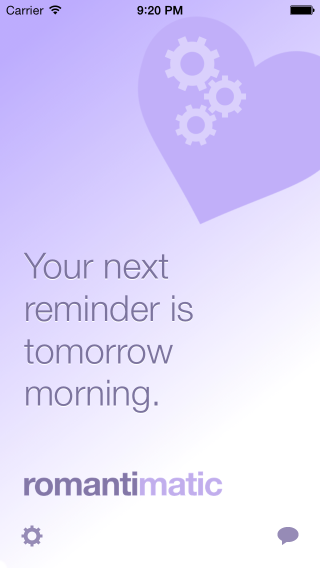
It comes with a couple of dozen predefined messages, and allows you to edit your own; it’s got a few settings for how often it sends the notification. That’s it. You could certainly do everything that the app does with your own brain, like people have been doing for tens of thousands of years. (Pre-verbal grunting was the texting of the Late Cretaceous.)
But I, at least, had trouble with it. I’m an over-focused nerd. Since you’re reading a blog, you may recognize the type, perhaps by looking in the mirror. I’d sit down in front of the keyboard and the time would sweep away, and I’d be left having spent another day without telling my wife how wonderful I think she is.
Thus, Romantimatic. It started out as a joke — the six billionth “There’s an app for that!” joke, in fact — but I eventually sat down to actually implement it. The result is software to remind you to pull your head out of your ass every once in a while. Judging by myself, such a thing should have an enormous market. Yes, it’s silly, but it also serves a purpose. Are you a chowderhead? Are you aware you’re a chowderhead? Have we got the thing for you!
I told someone that the app is a serious implementation of a silly joke about a serious need. I don’t know where that leaves it on the silly-serious spectrum, but I suspect it’s not a point but a range.
But, man, I was not prepared for the response. Woo.
I knew there would be some have-we-come-to-this tut-tutting. I mean, I’m not that oblivious. You attach software to the expression of romantic love, and some people are going to see it as cynical. We’ve wrapped code around almost everything in our lives, but deeply felt emotion is still supposed to be start-to-finish analog. You don’t put your anniversary on a calendar, because it means you’re a bad person who doesn’t care.
Except it doesn’t. It means you want to remember it. Your calendar is a tool and it helps you do the things you want to do. I see Romantimatic in the same light. If you’re not good at something and want to get better at it, a tool can help. Tools make things faster and easier and more reliable.
But the number of people who don’t agree — at least in the specific case of texting your sweetheart — has been a little staggering. Twitter is awash with “appalling” and “is this a joke?” and “this makes me feel ill”. And the most surprising members in the chorus of disapproval have been the nerds. Lots of nerds.
I don’t mean to play on stereotypes, but the app was basically written for nerds. These are my people. The whole notion of being so over-focused that an entire day goes by is basically nerd canon.
Plus, nerds are used to using tools, especially digital ones. They’re comfortable with it. They have entwined software deep into their lives, and like it that way. Beep boop beep, nerds! Greetings!
And that’s where the disconnect comes in for me. The presumption appears to be that using Romantimatic to prompt you to send a message to the love of your life automatically makes that message insincere. That if you need to be reminded, your love is somehow broken or false or meaningless. That’s what I don’t get. For people who deeply love technology, its effects and its impact, this one tiny corner case — a few dozen bytes of notification text — somehow makes me an overly-mechanized jerk.
The app has also been called a crutch, which I totally agree with. If you can’t walk very well, crutches are really, really handy. Maybe you’ll use the crutch forever, or maybe it will help you get to where you need to be, to walk on your own. But that doesn’t make the walking or the destination insincere.
I am — and please forgive me for putting this image in your head — a boiling cauldron of passionate love. But I’m also a small business owner who’s the parent of three teenage boys and has at least a foothold somewhere on the autism spectrum. Forgive me if I get distracted. At least I want to get better at it, right? Right? Hello?
There was not an ounce of insincerity or cynicism in the creation of Romantimatic — I mean, come on, it’s got “I love you” in High Elven included as a pre-defined text! — but I apparently did a lousy job of getting that across.
It’s funny, people! And maybe a little stupid-sweet. And maybe, hopefully, a little useful.
And available in the App Store for the low, low price of two dollars!

The second XOXO Festival — upbeat, exciting, inspiring, amazing — ended yesterday in Portland, and I’m on the flight back, and I and can’t stop thinking about failure. Disastrous, merciless, unrelenting failure.
XOXO is the distillation of everything that’s right about indie and maker culture. You can’t possibly be interested in what’s going on in those communities and come away not ready to dedicate (or re-dedicate) yourself to them. XOXO is a perfect place to be who you are, who you want to be, who you are becoming.
And, in one way or another, I’ve failed at each of those things, which is what makes me want to talk about it. Tech culture — and to a lesser degree, the indie community that comes out of it — does not, and desperately must.
It sounds both massively cynical and relentlessly despairing to come away from a wildly inspirational conference like XOXO, filled with people who are both successful and happy, and be most interested in the other side of the equation. I firmly believe that XOXO is perfect as it is — it achieves its goals brilliantly, almost magically — but indie culture at large (and I count myself as part of that culture) needs to be able to have open conversations about the risks, consequences and costs of pursuing your dreams… and failing. Not just business failure, not just financial failure, but personal and emotional failure as well. The decisions our dreams inspire have consequences, and if we imperfectly understand those consequences, the results can be devastating.
This is about how we evaluate risks, gauge costs, and — ultimately — accept and move on from the failure to achieve what we set out to. We cannot be whole unless we acknowledge, discuss and internalize the sometimes shattering consequences of taking a leap and plummeting straight into the ground. We’ve got the conversation about success down pretty well — probably too well, in fact, to where the topic almost automatically evokes the standard storyline of passion, struggle, victory. But until we can talk just as freely about failure, the story of indie culture remains a Disneyfied fairy tale — based on reality, but without the occasionally ugly ending.
Do you love your dream enough to sacrifice your life’s savings? Your marriage? Your oldest friendship? Your mental heath? In more than a handful of cases, your life? These are real-world consequences of failure. But if and when they are discussed, it’s over beers, quietly, in the back-channel. When the topic gains a wider audience, it’s almost mercifully in regards to a single, sad incident — Aaron Swartz dreamed big dreams, for all of us, and however you trace the lines, they ultimately cost him his life.
There are hints of a wider conversation out there. At XOXO, Cabel Sasser spoke movingly about what sounded to my untrained ear like clinical depression, even in the face of inspirational material success and iconoclastic freedom. Marco Arment called his talk a therapy session, and detailed how he moved from grinding fear, through personal understanding, to a new approach to his career. Jack Conte charted the collapse of his self confidence in the wake of a hit.
But how many people looking for investment can openly talk about their anxiety? How many people who are financially successful can discuss the end of their marriage? How many people have seen their dreams collapse to dust in front of them and are expected to pick themselves up and get back to it?
This is not about putting together a conference about failure (FailCon 2013 — sign up now, loser!), or adding a handful of cold-water speakers at existing conventions, or opening up the mic for five-minute stories about lessons learned. It’s about doing the deeply hard work of removing the failure taboo from our culture, allowing the human beings who try — and try hard — and don’t make it to not have to keep the fucking grin plastered to their face, for fear that they’ll be treated as damaged goods.
There is a term in statistics called “survivor bias.” If all you look at are the survivors of a particular population over time, you’ll come away with a mistaken understanding of the probabilities of success. Which pretty well describes the vast majority of public conversation in indie culture. We rightly celebrate the people who have taken chances, found audiences, and secured their financial and emotional success. So much so that it’s become (at best) rare and (at worst) scandalous to even publicly mention failure or crisis or fear, except as a stumbling block to overcome. Failure is temporary, an opportunity, a lesson. Pivot! On to the next thing! Upward and onward!
Which only serves to make true failure — real, lasting failure — feel that much worse. Sometimes failure is not something you bounce back from. Sometimes, it’s something you grow around. Sometimes, it’s something that you seal away and try to forget. Sometimes, it’s something that stays with you every second of every goddamned day.
XOXO was a place where conversations like these took place — both on stage and among the attendees — and it must continue. A cultural norm that requires relentless optimism — that mocks or derides or even just tries to ignore failures, be they economic or emotional — cannot survive. We are made of people, and unless each of us can speak, grow, and even fail as people — as complete people — we will never have a culture that can sustain itself beyond the enthusiasm that will inevitably sour into hype.
There are people who are telling these stories, and the more who do, the better it will be, for everyone.

I was lucky enough to get to go to the XOXO Festival in Portland this past weekend, and I’ve read a lot that’s been written about it since, and, yeah, pretty much all of it is true. It was a wonderful time, special in a way that each person is putting his or her own spin on: it was the anti-South by Southwest, it was a love letter to the Internet, it was “disruptive creativity” made real. XOXO felt like each of those things, and many more. But to me it was the lack of something deeply familiar that marked it as unique:
It didn’t feel lonely.
I’m an introvert, not a particularly distinguishing trait among computer programmers. I generally don’t like crowds, and I especially don’t like crowds of people I don’t already know. I don’t like having to interact in real-time. All of it makes me feel tired and nervous and stupid. Oh, I’m sorry, excuse me — I’m faking a data center emergency on my phone so I can go over to the corner and read Twitter.
At XOXO, there were 400 people all together in the same room. Four hundred unique, potentially problematic souls and I knew maybe 5% of them. I’d be lying if I said I wasn’t just a bit of a wreck going in.
And then it started, and it flew by and not for one second did I feel awkward or adrift or lonely. I didn’t second-guess myself. I didn’t want to crawl into a hole and die. I don’t think I can say that about anything like it before.
I’ve been to a handful of festivals and more than a few meetups and the odd couple of professional events over the years, and without exception there’s been a moment at each where I think, “What the hell am I doing here?” The people — their conversation, the agendas that underlie that conversation, the motives that underlie those agendas — eventually feel otherworldly, and usually sooner than later.
I attended a “founders meetup” once, during a failed entrepreneurial phase, and lasted all of half an hour, including the time it took me to drink a beer in the hopes it would numb the intense urge to flee. But after a handful of conversations about funding and VCs and term sheets and a whole host of other crap that nobody interesting could possibly make the primary motivator of their life, I did flee, out the door and off on a long walk that consisted largely of the glacial realization that this was not a world I was cut out for.
After that happens enough times, you start to feel like maybe there isn’t any world you’re cut out for.
XOXO itself was a pleasure. The logistics were astonishingly well-handled, and everything from the building to the food to the A/V to the after-events to the bathrooms appeared effortless. As a physical reality, XOXO worked.
But, more importantly, as a collection of like-minded people, as the expression of a philosophy, as a new and powerful approach to work and art and achievement, XOXO shined. I’ll leave it to others smarter and more articulate than me to describe the details — each speaker took a turn removing marble that wasn’t part of the statue — but the upshot is that if you are of a particular mind, a particular bent, there is now a place for you. A place to talk and share and experiment and explore. A place to feel among friends. A place to not feel lonely.