I don’t know what depression feels like for other people, but I can tell I’m headed down into the muck when my internal monologue turns against me. It’s got a handful of phrases that it repeats over and over when things start to go bad, and one favorite is “Nothing you do matters.”
I’ve been getting that one a lot lately. I know, rationally, that it’s not true. A lot of what I do matters, to my family and my friends and myself. But, you know how it is: this is my mental illness; there are many like it, but this one is mine.
Why this particular phrase at this particular time stings so much is because it’s not entirely untrue, specifically with regard to my profession. I’m a computer programmer, see, and there has been a lot going on.
AI.
Sigh.
They rhyme for a reason.
I’m not talking about the razor-sharp edge, where people eagerly bleed, running AI-based agents that free them from the burden of responding to e-mails from their friends. (Or people who were formerly their friends, given they don’t rate an actual response.)
And I’m not talking about the churning, smoking, shambling software production stacks inspired by dystopian hellscapes. (The Mayor of Gas Town is literally named “The People Eater.” Little too on the nose there, pal.)
And I’m not talking about the grand philosophical debates from our deepest thinkers and our best minds, if computers have risen to sentience, to consciousness. (Spoiler: No. Don’t be stupid. Jesus.)
And I’m not even talking about the moral, ethical, social, environmental, or economic impact of AI, because nobody else is either. Boooring.
What I am talking about is being replaced, about becoming expendable, about machines gaining the ability to adequately perform a very specific function that was previously the exclusive domain of skull meat.
What I’m talking about is that nothing I do matters. That nothing I can do matters.
In just the past few months, what was wild-eyed science fiction is now workaday reality. I’ve been dubious about the prospects of LLMs creating code (and lots and lots of other things) for as long as they’ve existed, but it’s hard to argue with the latest wave and their abilities from a purely practical, purely capitalistic, purely ship-something-anything perspective — the perspective that pays the bills. I’ve seen self-professed non-technical people bring functioning code into being, and that bests a significant number of actual humans I’ve worked with.
The legend has John Henry — the very best in the world — winning his battle against a machine, only to lose the war by, y’know, dying. And I sure as hell ain’t no John Henry. How many steel-drivin’ men take one look at their new opponent and just walk away? How many are making the right decision by doing so?
There are a thousand factors at play here (most of which are still in motion) but for plenty of small-scale, snap-together projects, something like Anthropic’s Claude Code or OpenAI’s Codex will be good enough, for economically-viable values of both “good” and “enough.” They’ll either burp up scripts that simply wouldn’t exist otherwise, or do (some of) the work of (some) junior or mid-level coders (somewhat) faster and cheaper. But the direction things are headed seems pretty clear.
Is the code any good? I don’t know. Who cares? Nobody looks at it anyway. AI produces a result, and results are what matter, and if you’re waiting for quality to factor significantly into that equation, I’ve got some bad news about the last 40 years of professional software development for you.
There are plenty of people I know — they’re not all professional programmers, but most are; people I respect and admire and envy — who have enthusiastically embraced this particular steam engine. Paul Ford wrote a wonderful essay about both his qualms and his excitement — Qualms: 4, Excitement: 6, final — and if what was being replaced wasn’t the basis for my definition of self, I might feel the same. I can ignore moral, ethical, social, environmental, and economic externalities just as well as the next guy.
But I am a programmer. Just like I’m a father and a husband and a son and a friend. It’s not something I do, it’s something that is fundamental to the core of my being. Like overly dramatic phrasing.
I got into computers because solving puzzles was fun, and building worlds was fun, and making things — the process of making things — was fun, down at the granular level. It was nice to have something at the end, but the act of creation was the exciting part. I suspect that predilection will begin to disappear (in commercial environments, at the very least), now that the people who do it — who want who do it — can be replaced. The journey actually was the reward for some subset of weird little freaks, but you can now skip all that crap and just jump to the end and get on with it.
People will argue that speaking English to LLMs is just another level of abstraction away from the physics of how the machine actually works. And while that’s technically true — the worst kind of true — it also misses the point. Industrialization fundamentally changes things, by quantum degrees. A Ding Dong from a factory is not the same thing as a gâteau au chocolat et crème chantilly from a baker which is not the same thing as cramming chunks of chocolate and scoops of whipped cream directly into your mouth while standing in front of the fridge at 2:00am. The level of care, of personalization, of intimacy — both given and taken — changes its nature. Digging a trench is a very different thing than telling someone to dig a trench. Assembling a clock is a very different thing than asking Siri for the time.
I was lucky enough to have a trench-digging enthusiasm when it was economically advantageous to do so. I managed to pretty much exactly hit the window when deep-nerd brain chemistry could produce a viable, even lucrative, career. I am fortunate to be able to lean into an early senescence and walk (or be pushed) away, as what I want to do and what the world wants me to do diverge.
It still makes me sad, though, that what I’ve spent 45 years of my life toiling at will likely end up as a footnote, the providence of folksy artisans and historical reenactors. I didn’t leave a dent in the universe so much as splatted against it. The world no longer has a need for what I somewhat sardonically call my art. We are all product managers now, pleading with obtuse underlings to go back and try again and to get it right this time. I remain a father and husband and son and friend, but the need for what I can do — the need for what programmers can do — is shrinking, and my conception of myself and my usefulness along with it.
There will be more software than ever, as its production is automated; we are entering the industrial age of the digital age. But less of this code will be elegant, or considerate, or graceful. Less of it will be created by removing what isn’t David, and less of it will be driven by a human understanding of human needs.
That was something I did that mattered. I’ll miss it.
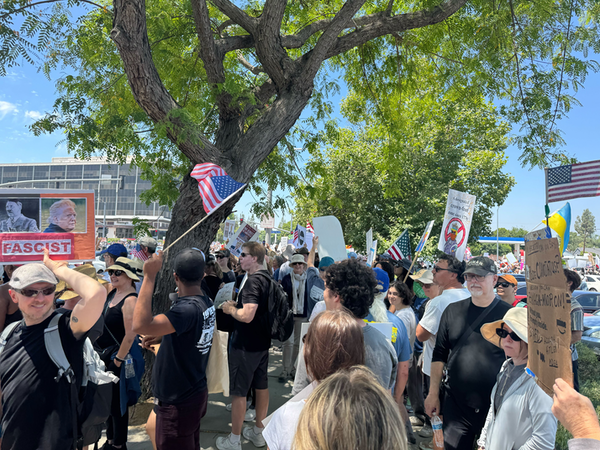
If it were me, I would simply choose not to be on the wrong side of history.
Well, we did end up with a TACO truck on every corner, but not in the way we meant.

I think my favorite thing about leaked LLM system prompts is that they codify what programmers have been screaming at, demanding from, pleading with software to do for decades.
This sentiment could come from any time between Babbage and now: “For the love of all that is holy, please just goddamned work, just once! Do not give me the same error you have before! I do not care about that particular corner-case you are obsessed with, and I want you to just do as I fucking say!”
Only now, instead of landing as flecks of spittle on the monitor, it’s checked in and versioned.
- do as I fucking say!
+ do as I fucking say, _please_!
A while back, one of my kids and his girlfriend and some mutual friends of theirs went to Las Vegas to celebrate her birthday over a long weekend. As young people are wont to do, they booked the crappiest hotel for the cheapest price, to have more money to hand directly to the casinos. I did exactly the same thing when I was their age.
But Vegas has changed, and fraying carpets and broken sinks are not the only terrors that away you on the low end anymore.

I have been a programmer for a very (very) (very) long time and it is my considered (and correct) opinion that the best software development methodology is not Agile or Waterfall or Spiral or Scrum or Kanban or Rapid Application Development or Feature-Driven Development or Test-Driven Development or Extreme or Lean or Joint Application Development or any of a couple of dozen others produced by people with books to sell and seminars to schedule.
The best software development methodology consists of one person with a list of things to do in a text file. If a piece of software cannot be development via this method, it should not be developed at all. Such things have only gotten us in trouble.
In very, very rare circumstances — operating systems, the space program, any AAA video game I like — the second-best software development methodology is allowed. This consists of a team of four or five people who share the text file and go out to lunch together every day but don’t talk about work.

We are — as all good people are — Dodgers fans, and so we get taken out to the ballgame, and we root, root, root the home team, and if they don’t win it’s a shame, and then we go get milkshakes.
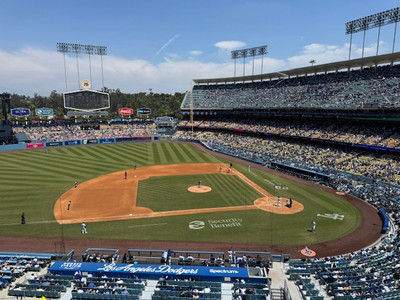
I can’t tell you how we started doing this — other than a vague sense that there should always be milkshakes — but I do know that any time a game ends, we take the Academy exit, turn onto Stadium Way, and then merge with Riverside. A couple of miles down the road, at the intersection with Fletcher, there’s Rick’s.
Rick’s is… an institution. That’s a polite way of saying it’s got three and a half stars on Yelp. I’ve never actually eaten their food, but the shakes are good and it’s got a greasy-spoon charm and they’re open after games and it is an institution.
During the pandemic, they put “SPAGHETTI IS BACK” on their marquee, and it went viral, because we were all kind of nuts in 2021.
Yesterday, as a buddy and I were driving-through to get milkshakes — Dodgers: 12, Marlins: 7, in a game that had more bad fielding than I’ve seen before in my life, combined — the sign had this:
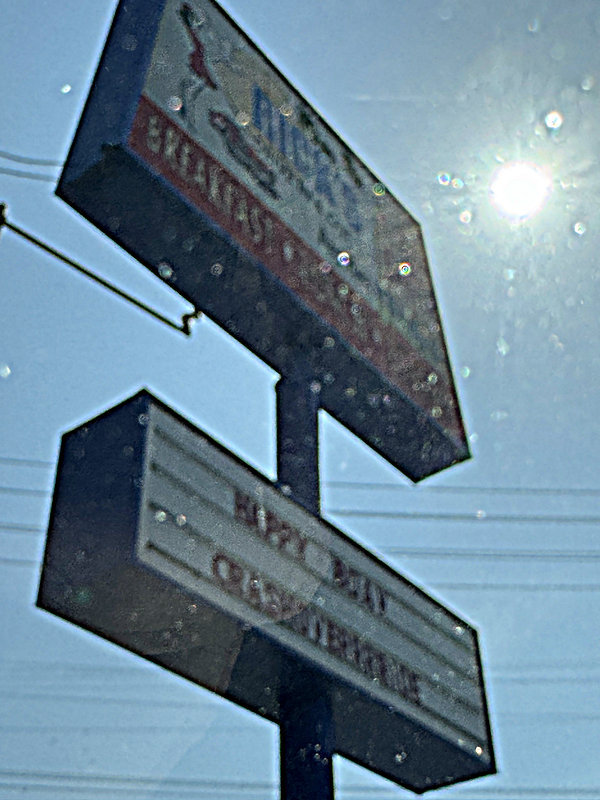
(Yes, I know it’s a bad photo. My windshield was so dirty, the phone focused on that instead of the actual sign. Leave me alone.)
It said, “HAPPY BDAY CRASHOVERRIDE”. Which, no, it couldn’t possibly have.
“Crash Override” is the hero from the much-beloved and genuinely bad 1995 nerd movie “Hackers,” which posits that technically proficient people look like Jonny Lee Miller and Angelina Jolie in their mid-20s.
How? Why? What?
Maybe it was the release date? No, “Hackers” came out on September 15. Miller’s birthday? No, that’s November 15. Maybe they filmed some of the movie at Rick’s? No, it was shot in New York. Maybe they meant “HAPPY BIDET CRASHOVERRIDE”? I don’t know.
And so I committed the smallest act of journalism possible, which should qualify me for a Pulitzer given how things are going: I called the restaurant.
I said, “This is a weird question, but I came by last night after the game and saw the marquee said ‘HAPPY BDAY CRASHOVERRIDE’ and I was wondering if you knew why?”
And the poor woman who happened to be standing closest to the phone when it rang said: “I don’t know. The customers write stuff down and we put it up and we don’t know what it means.” Which, I admit, is disappointing and leaves me with no ending to this story.
Good milkshakes, though.
My son calls the achy-muscled, sticky-mouthed aftermath of falling asleep on the sofa while watching TV “waking up on Roku Road.”
 Atom Feed